"Which jumbo roll tissue brand is best?" — it's one of the most common questions procurement teams, building managers, and business owners ask. Whether you call it JRT (Jumbo Roll Tissue) or jumbo roll toilet paper, it's the same product every commercial restroom depends on.
But after 25 years in this industry, here's my honest answer: the question itself is slightly off — there is no single "best" brand. There's only the brand that's best suited to your specific use case, and the way to find it is by evaluating criteria, not brand names or the price tag.
Organizations that choose tissue based on "price per roll" often end up paying more than those who choose based on "actual cost per use" — even though the quote looked cheaper.
What Is JRT — How Is It Different from Regular Toilet Rolls?
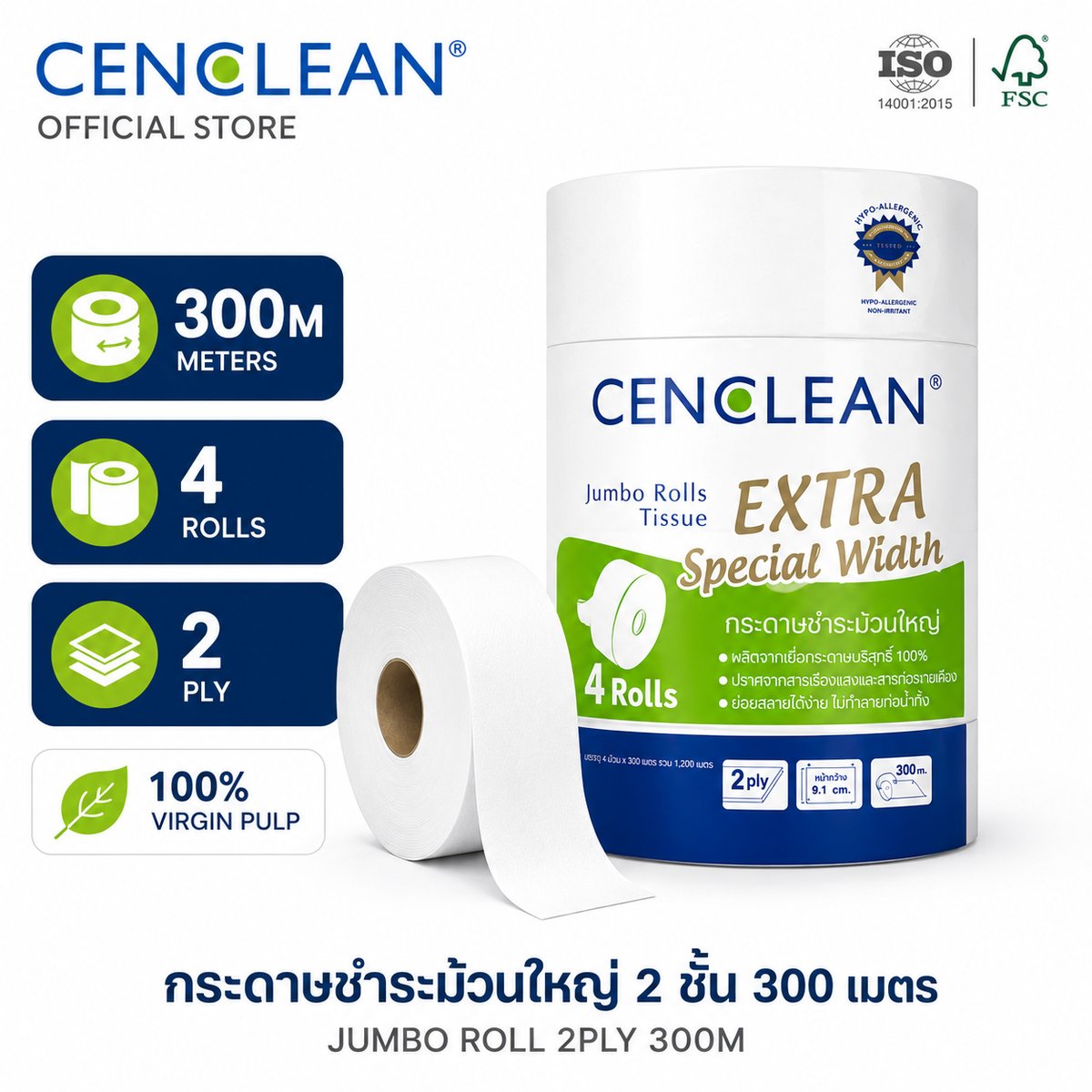
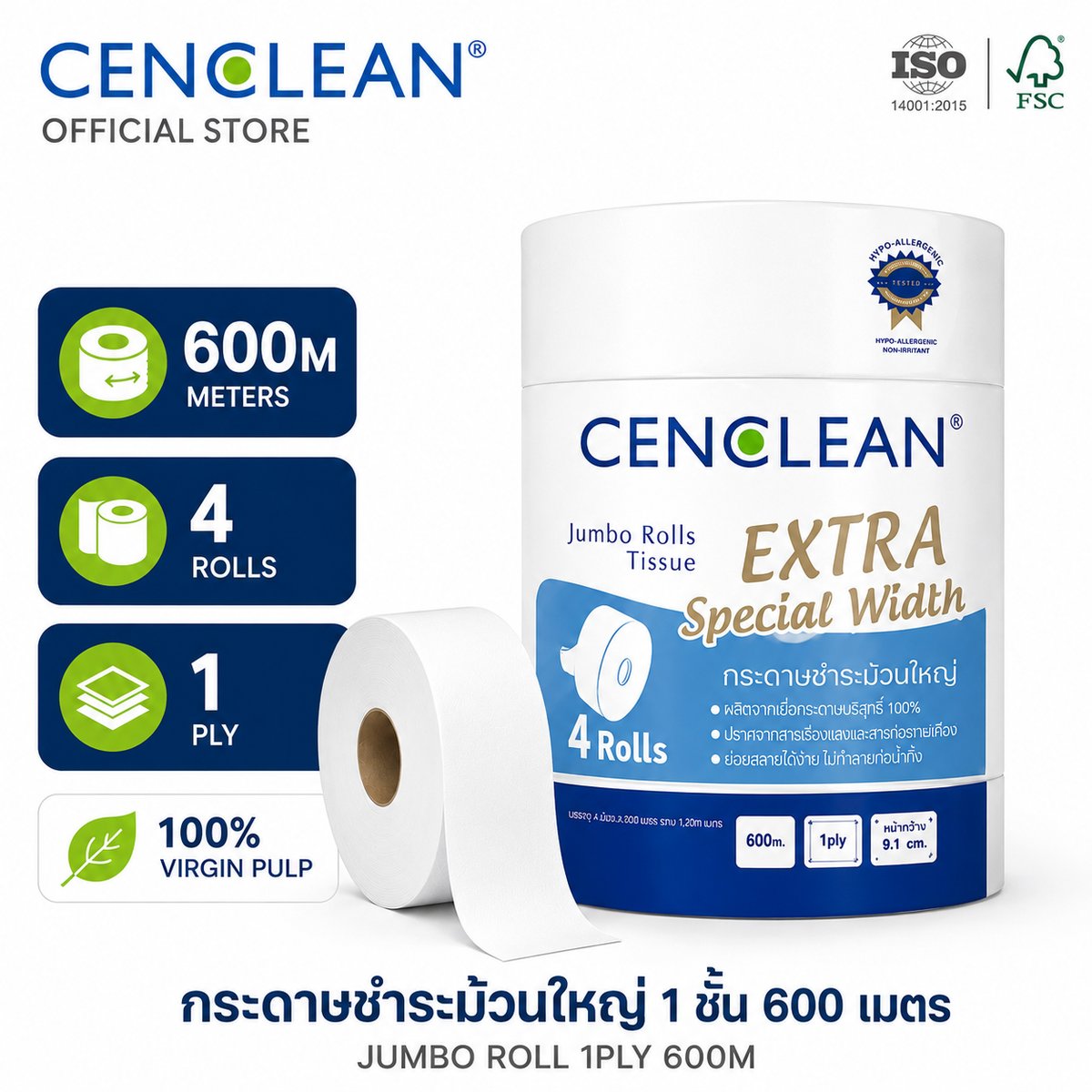
Jumbo Roll Tissue is toilet paper designed specifically for commercial use. The standard lengths in the Thai market are 2-ply 300 meters and 1-ply 600 meters, packed 12 rolls per carton — compared to household rolls that run only 17-32 meters.
There are 3 reasons commercial restrooms — hotels, offices, hospitals, shopping malls, factories — use JRT instead of household-size rolls:
- Fewer refill rounds — housekeeping isn't running to restock every 2-3 hours, reducing workload and the risk of "running out with nobody noticing"
- Lower cost per meter — bulk wholesale pricing beats small rolls for the same total length
- Controlled usage via dispensers — reduces whole-roll theft and unnecessary over-pulling
6 Criteria to Compare Before You Sign a Purchase Order
Whichever brands you're comparing, run through these 6 points one by one — the brand that answers all of them with proof is the one that deserves a place on your shortlist:
Ply count — 1-ply or 2-ply should match the user, not the price
2-ply 300m suits image-sensitive spaces (hotels, offices, hospitals) because it feels better and users pull less. 1-ply 600m suits very high-traffic areas where reducing refill frequency is the priority.
Real length must match the label — and roll size should be measurable
Every label says 300 meters, but the real thing can vary. Three quick checks without unrolling the whole thing: measure the width (some brands are only 8cm when the standard is 9cm), measure roll diameter, and weigh rolls against each other. Note that width has a normal manufacturing tolerance of ±2-5% — but a difference beyond that (missing a full centimeter, for example) isn't tolerance, it's a different spec entirely.
Pulp — virgin pulp or recycled + OBA
Recycled-pulp paper is often treated with optical brightening agents (OBA) to look whiter. Thailand's Department of Science Service has previously issued a warning that OBA may be linked to skin irritation and long-term risk, particularly at points of direct skin contact. You can test for this yourself with a UV light (see below).
Water disintegration — good tissue shouldn't clog your toilets
Quality toilet paper should break down readily under the force of a flush. One clogged-pipe repair can cost more than a full year's price difference between brands. Ask the supplier for disintegration test results before deciding.
Core size and diameter — the hidden cost point most people miss
Check two things: (1) the roll must fit your existing dispenser — always test one roll before ordering in bulk, and (2) watch out for the "big core" trick — a roll with a large core (e.g. 7.5cm) but small diameter (18-18.5cm) looks like a normal roll from the outside, but contains noticeably less paper than a small-core roll (4.5cm) with a full 24cm diameter.
Batch consistency + after-sales support
Great first batch, thinner every batch after — a classic problem when buying through middlemen who keep switching manufacturers. Choose a supplier with a clearly identified source, consistent stock, and someone accountable when something goes wrong.
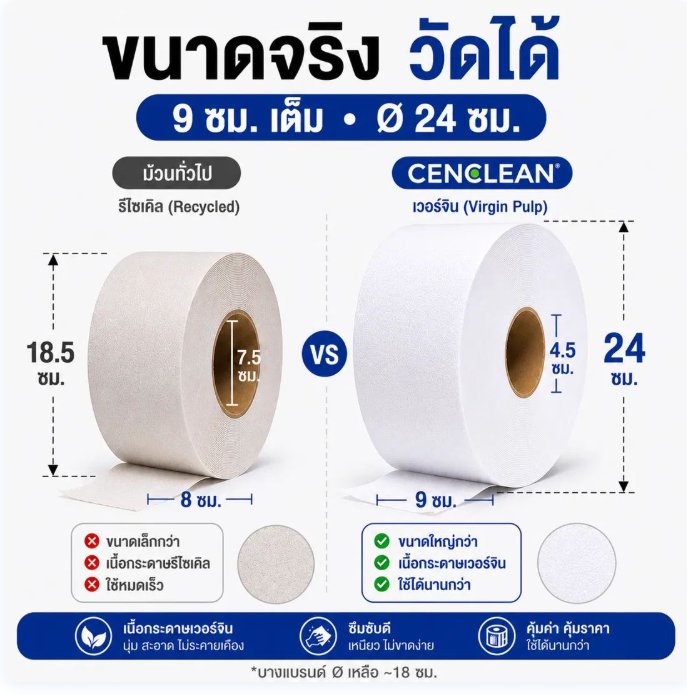
Real, measurable sizes — a big-core, small-diameter roll can look the same at a glance, but clearly contains less paper (*some brands measure as low as ~18cm diameter)
The Most Expensive Trap: Price Per Roll vs. Real Cost Per Use
This is where many organizations lose money without realizing it. Here's a sample calculation to illustrate the thinking (figures are illustrative, not actual quotes):
| Comparison point | Tissue A (cheaper) | Tissue B (pricier) |
|---|---|---|
| Price per roll (example) | ฿85 | ฿112 |
| Measured actual length | 255m | 300m |
| Price per meter | ฿0.333 | ฿0.373 |
| Length pulled per use (thinner paper = more pulled) | ~100cm | ~70cm |
| Cost per single use | ฿0.33 | ฿0.26 |
Tissue A looks 24% cheaper on the quote — but is actually about 27% more expensive per use. That's before counting hidden costs: more frequent refills, user complaints, and clogged-pipe risk.
When an organization says "we switched to a cheaper option and saved money," the question worth asking back is: saved based on the purchase order figure, or saved on total system cost? The cheapest tissue on the quote is often not the cheapest tissue by the end of the fiscal year.
Test Quality Yourself Before Ordering — No Lab Required
Before committing to a large order from any brand, request a sample and run these 2 tests — takes less than 5 minutes combined:
🔦 UV Test — Detecting Optical Brightening Agents (OBA)
Use a UV light (a banknote checker works fine) at a distance of 10-15cm. Paper containing OBA will fluoresce bright blue immediately, while 100% virgin pulp paper shows little to no fluorescence.
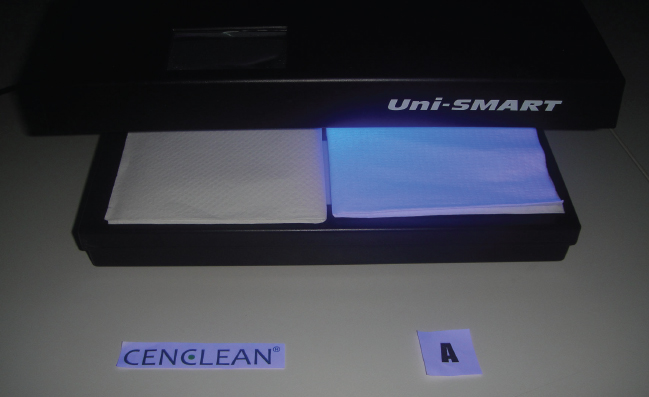
UV Test — paper containing OBA fluoresces bright blue; 100% virgin pulp paper does not fluoresce
💧 Water Test — Detecting Recycled Pulp
Cut equal-sized samples and soak them in water for 30 seconds. Recycled-pulp paper breaks apart into fragments, while virgin pulp paper holds its shape (while still disintegrating properly under toilet-flush force — these two properties aren't contradictory).
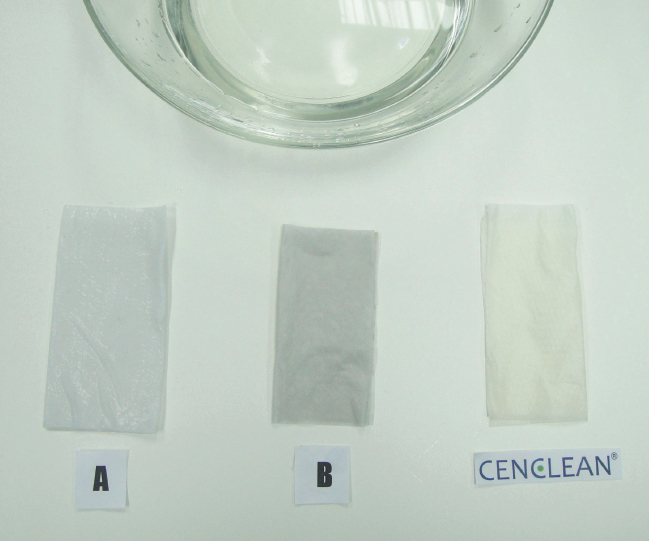
Water Test — after 30 seconds in water, recycled-pulp paper breaks into fragments while virgin pulp paper holds its shape
For the full step-by-step test with photos at every stage, read our article Hospital Tissue Paper — Check Before You Use, It's Safer Than You Think, which tells the real story of a public hospital that used OBA-treated paper for years without knowing it.
Frequently Asked Questions
Q: Is 1-ply 600m or 2-ply 300m more economical?
It depends on actual use — 1-ply gives more length but users tend to pull more to compensate for thinness; 2-ply feels better and users pull less. Short answer: image-sensitive areas → 2-ply 300m; very high-traffic areas focused on reducing refills → 1-ply 600m.
Q: How long does a 300m roll last?
At an average pull of 60-80cm, one roll supports roughly 375-500 uses. An office restroom with 40-60 uses per day would get through a roll in about 1-2 weeks (actual figures depend on user behavior and paper thickness).
Q: Why are some brands so much cheaper even with identical specs on the label?
The difference is inside: recycled pulp + OBA + real length that may not reach the label + thin sheets requiring more pulls per use. Labels can say anything — but a UV light and a scale don't lie.
Q: If I switch tissue brands, do I need to change the dispenser?
Usually not. Standard JRT dispensers accommodate rolls up to roughly 24-25cm in diameter and multiple core sizes — but always test-fit one roll in your installed dispenser before ordering in bulk.
Q: What's the minimum order for wholesale pricing?
This varies by supplier. Typically starting from 1 carton (12 rolls), with volume discounts beyond that. Organizations with regular usage should ask about annual contract pricing to lock in rates and guarantee stock availability.
So What Makes CENCLEAN Different?
This article is meant to help you choose any brand wisely — but if you're asking where we stand on the 6 criteria above, here's our answer:
- 100% virgin pulp, no added OBA — verifiable with a UV Test and Water Test on every batch, and tested Hypo-Allergenic (Non-Irritant) for sensitive skin
- Full length as labeled, 9.1cm width (standard manufacturing tolerance ±2-5%) — 2-ply 300m and 1-ply 600m, weighable and measurable
- Verifiable certifications — FSC® (raw material from responsibly managed forests, aligned with ESG/green procurement policy), test results from Thailand's Department of Science Service, and manufactured at facilities certified to ISO 9001 and ISO 14001
- Trusted by real organizations — hospitals, banks, hotels, and leading office buildings (see client references on our website)
- A complete ecosystem — tissue + dispensers + our Smart Hygiene System for real-time usage tracking, for organizations that want to control costs with real data
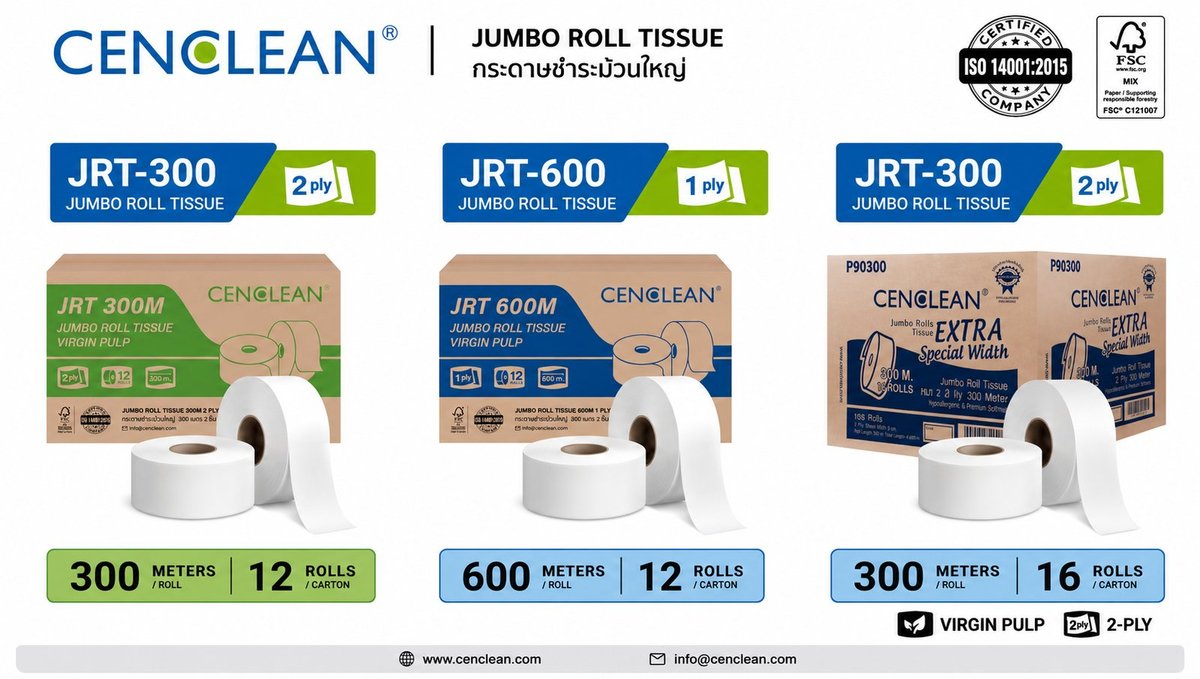
CENCLEAN's JRT lineup — JRT-300 (2-ply), JRT-600 (1-ply), and JRT-300 EXTRA Special Width
Standards CENCLEAN Fully Meets
Every CENCLEAN product is manufactured under FSC® (sustainable forest management), ISO 9001:2015 (quality management), and ISO 14001:2015 (environmental management) certifications.

Want a sample to compare against the brand you currently use?
Request a CENCLEAN jumbo roll tissue sample plus a wholesale quote for your organization — run the UV Test and Water Test side by side. Free, no obligation.